
How to add interfacing to vinyl/ faux leather
The vinyl/ faux leather can be used without any interfacing in some bags; in this case, a heavyweight fabric for lining is desired. It depends on the look you want for your bag.
You can opt to add interfacing for added body and structure but also to add a lovely texture to it. I wanted to quilt my bag panels and that’s why I chose a foam interfacing.
Foam comes in both fusible and non-fusible versions. Here are some foam brands you find on the market: Bosal In-R-Form (sew-in and fusible), Pellon Flex Foam (sew-in and fusible) and Soft and Stable by Annie (sew-in).
See below a few ways to add foam to the back of faux leather
1. Use lightweight fusible interfacing
Use this technique when the pattern requires seam allowances removed from the foam; see below that the foam is smaller than the fabric.

It does not matter if the foam is fusible or sew-in.
Add on top the lightweight interfacing, fusible side down (this is woven, but non-woven can be used as well), and press.
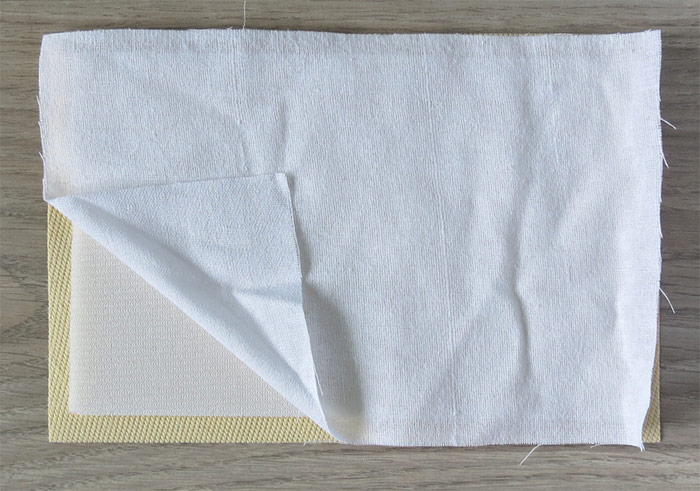
This is the result, the back side…
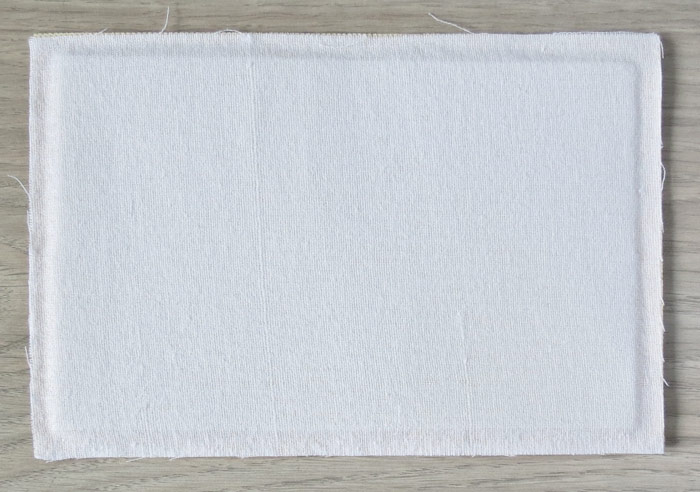
and here is the right side.

TRENDING patterns



2. Use parchment paper (baking paper)
If the foam is fusible, add it on faux leather, fusible side down and on top of it add a piece of parchment paper; press with a hot iron for 8-10 seconds, maybe more. This really depends on the type of foam and the thickness of faux leather. Do a test first on a scrap. Make sure you do not press for too long, so you don’t damage the material. I did it on a piece and could not believe how great it worked.

If you don’t feel like using the iron, there are other options, see below.
3. Use a basting spray
This spray is so useful that I buy it in bulk!
This is my favorite way of keeping the layers together, it’s quick and easy, I used it on all the pieces for my new patterns and I just love it.

4. Baste the layers by machine
If you don’t have a basting spray, just baste the layers by machine: using a long stitch, sew close to the edges. It works when the pieces have the same size (you don’t remove the seam allowances of foam).
Quilting faux leather/ vinyl
Once you have your panel interfaced, you can quilt it in the desired way.
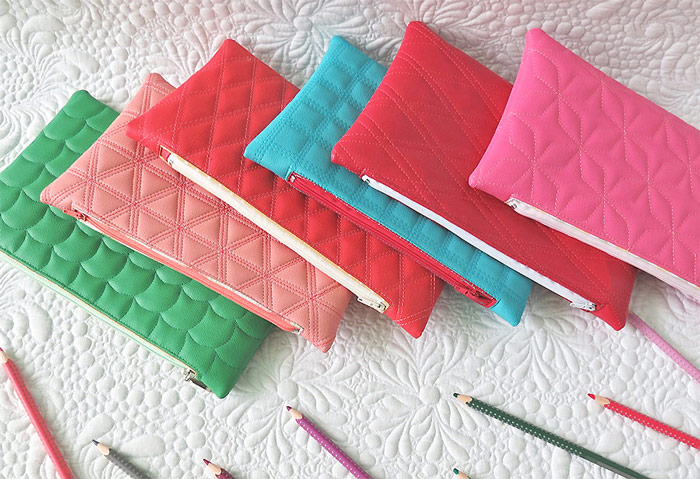
The easiest way to quilt is from the back (foam) side. If there is a complex pattern, I like to print it on paper, I add it on top of the foam and quilt through all the layers. Straight line quilting with the walking foot is quick and fun, and easy. See below some examples.
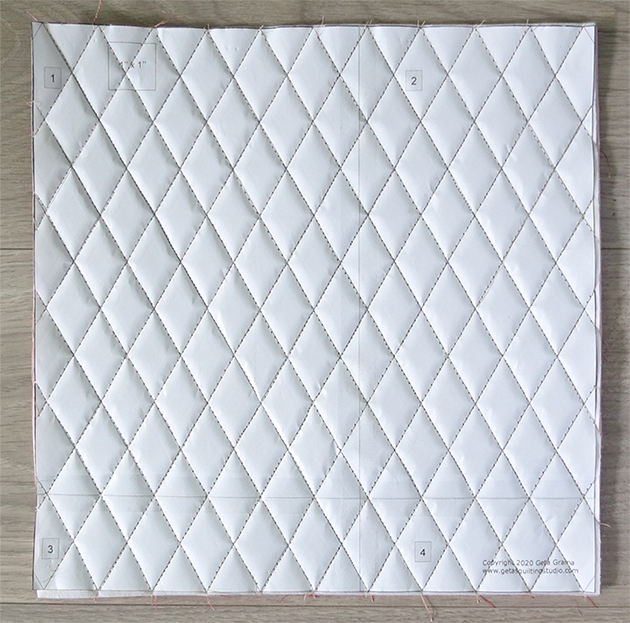

You can free-motion quilt your panels as well; you need a little practice here!


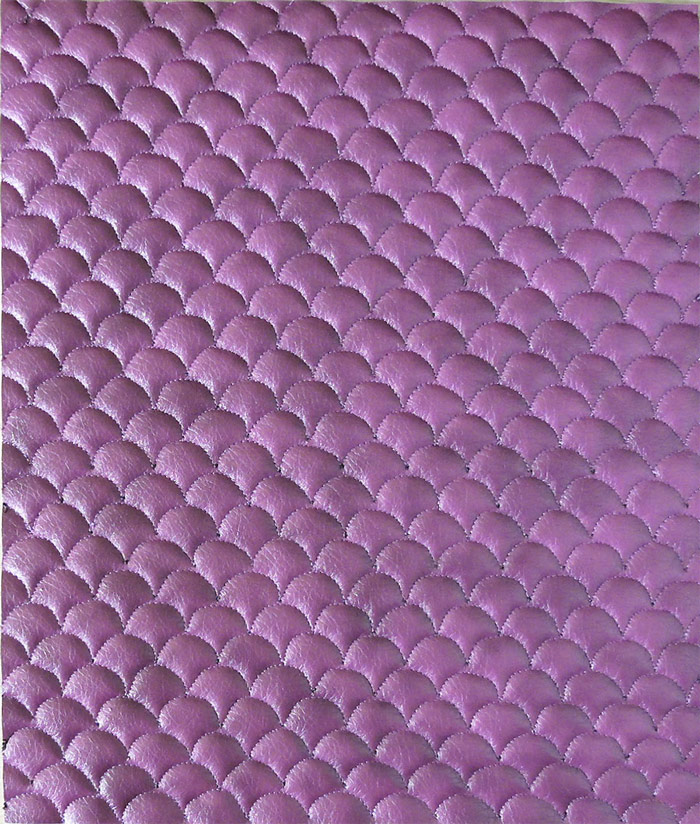

Again, stitched with the walking foot:


My biggest problem with foam!
What to do with the leftovers?? My pile of small pieces of foam is growing continuously; the foam I use is imported and not cheap and of course, I want to use any scrap of it. The experience of sewing these pouches gave me an idea – more about it below. But before that, two more ideas:
- if you are serious about sewing bag, buy wide foam; I find here only 18” wide foam, but it comes in 56” width as well.
- the long and narrow pieces can be used for interfacing the straps of the bags

Here is how to make a big foam piece from a few small pieces.
Trim the edges of each piece with a rotary cutter- you need a perfect edge.
Lay them next to each other as shown below.
If the foam is fusible, place the pieces on the back of your fabric, fusible side down.

If the foam is not fusible, keep the pieces together with masking tape.

On the other side, add a piece of a fusible lightweight interfacing, woven or non-woven. Then press. The interfacing will keep the foam pieces together.

Add it on the back of a fabric, use basting spray to keep the layers together, or baste the layers then quilt as desired (stippling is fine).

A grid quilting works as well.

You can’t say there are three pieces of foam on the back of this fabric. I am very happy that now I can save some of my foam leftovers.

Isn’t foam available to you?
I imagine the Bosal foam and the other brands are not available everywhere. So if you don’t have access to this type of foam, you could try the foam used in upholstery. See below what I found in Romania, accidentally.
On top there is BOSAL foam and under it there is the upholstery foam.

The difference between them is that the upholstery foam is not as dense as the other foam. But that is a good thing in case your sewing machine doesn’t handle bulk very well.

Here is a piece stitched with that upholstery foam…

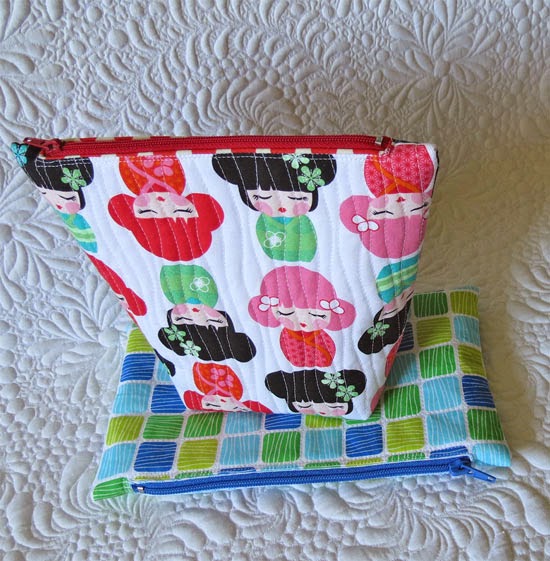
and the finished pouch.

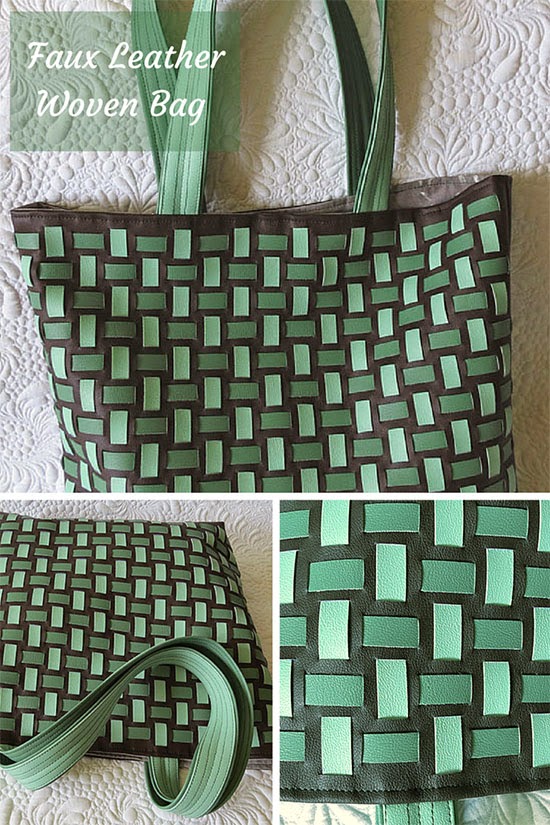
I also used this foam to quilt the front panel of this bag. This vinyl was thicker than the one used for the back of the bag so the difference in density was welcome and worked great for this bag.

I still have something to share with you about this bag – tomorrow! I promise it is fun!
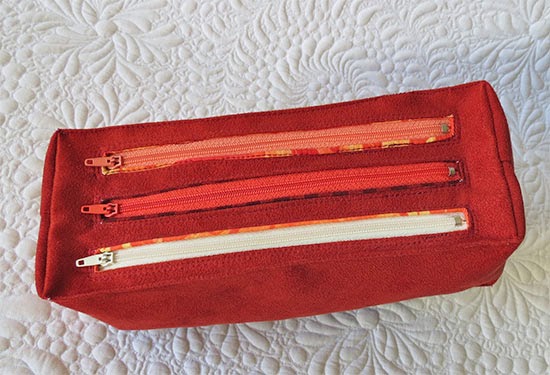
The pattern for all the pouches shown here is here.
Happy sewing!


Brilliant idea Geta! I have tried zigzag sewing foam pieces together but the stitching left a clear indentation in the foam. It never occurred to me to use a piece of fusible interfacing to hold it together. I have a whole basket of bits and pieces I will have to work on now.
Great post! I have found that when piecing batting together I overlap the pieces slightly, then cut through both pieces in a meander (using the rotary cutter). Then it is even easier to match the pieces together afterwards. Maybe worth trying for the foam as well? Best wishes from Brit
Brit, I tried to cut the foam in a wavy pattern but it did not work. The cut must be perfectly vertical, otherwise the pieces don’t fit next to each other. Because the foam is dense and thick, it is very hard to cut through two layers. Anyway, even when cutting with the ruler you have to pay attention! My pieces shown in the tutorial do not fit PERFECTLY and because you mentioned this, I realized the cuts I did were not perfect!
I use the smallest foam bits as stuffing in things. Cut them into confetti size and it works great.
Pieces too small to sew together but too large to want to cut I glue to the underside of things, like candle holders, to keep them from scratching the surfaces of furniture.
I had two antique mini metal sad irons and glued some to their bottoms so I could use them as weights for on top of quilt rulers and it wouldn’t scratch the rulers.
You’re patterns are so wonderful! You also share all your grate tips on how to handle the fabrics and interfacing. Thank you!
I am very glad to hear that this helps, Brenda! Thank you so much for mentioning this!
holding pieces of foam together with fusible woven is great idea! Will be trying very soon as I have a new bag in process