
Quilt Piecing Tips
Quilt Piecing Tips
Let’s confess! How many of you stitch over pins? I stitch!! The only exception is when I stitch multiple layers of thick fabrics- in bags.
But I would advice anyone to avoid stitching over pins. A machine needle hitting a pin could break and hit your eye. Or it could damage your sewing machine. It happened to me once and the machine needed a repair.
If you choose to stitch over pins, here are a few safety tips:
- use fine (thin) pins
- do not stitch with very short stitches
- pin perpendicular to the edges
- stitch slowly
- wear glasses
Chain piecing
This is a time saver technique that allows you to sew a number of different units (two pieces of fabric) in one continuous loop.
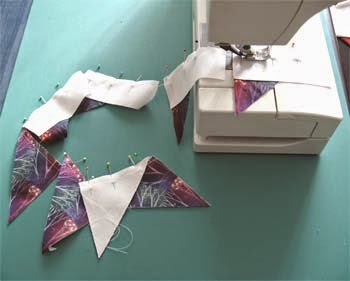
Start chain piecing by stitching the first pair of fabric pieces, then without removing them from the sewing machine and without cutting the thread, insert the next unit to be stitched. You don’t even need to lift the presser foot. Continue
stitching from one unit to the next. Then clip the threads connecting the units and move on to the next step in your quilt pattern.
A beginner quilter will use pins more often than an experimented quilter.
I think I was a beginner quilter for more than 7 years! I used pins for everything, even when I had to piece 2” squares together. Then I saw Eleanor Burns in a video piecing without pins and that was quite a discovery (yes, that disadvantage of no quilting friend to teach you something so simple but important!!).
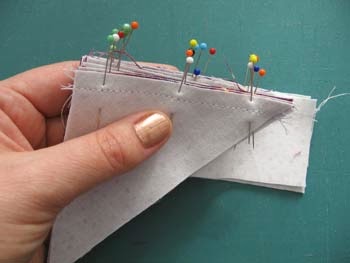
I still use pins when I need to match points, in blocks. And I always use pins when I piece rows of a quilt together-I piece faster and with more accuracy.So if you use pins and carefully stitch over them, remove the pins in bulk- another time saver tip! Stacking the pieces this way allows you to remove many pins at once.
How to piece different shapes together
Sewing square with square or triangle with triangle is easy.
But how about piecing different shapes (like triangle with rectangle or square; the edges don’t have the same size).
Here is a tip.
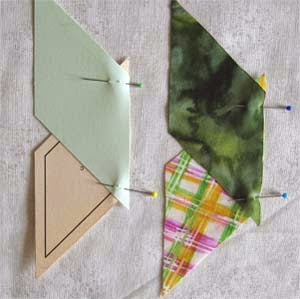
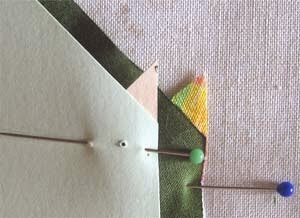
Draw those shapes on a piece of cardboard(paper is good too). Mark the 1/4 inch seam allowance (or whatever seam allowance you use) then cut out templates. Match the pieces and keep them together with pins.
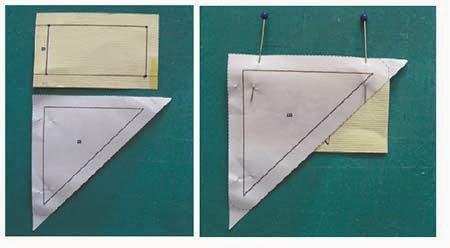
Keep them to hand and use them as reference- eyeball that little triangle when you piece your fabric.
You can use them for pieces of any size, if you use the same seam allowance.
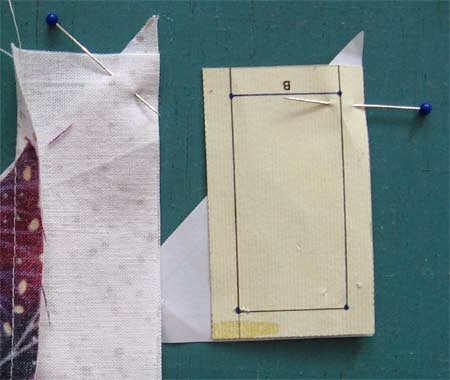
How about piecing diamonds? This helps a lot!

Enjoy piecing,
GetaPS. Thank you all who voted for

Thanks so much for the tips, Geta. I have always had difficulty piecing triangles with squares. Now I will follow your suggestion with the paper pieces and I am sure my "piecing" life will be much happier. Sharon
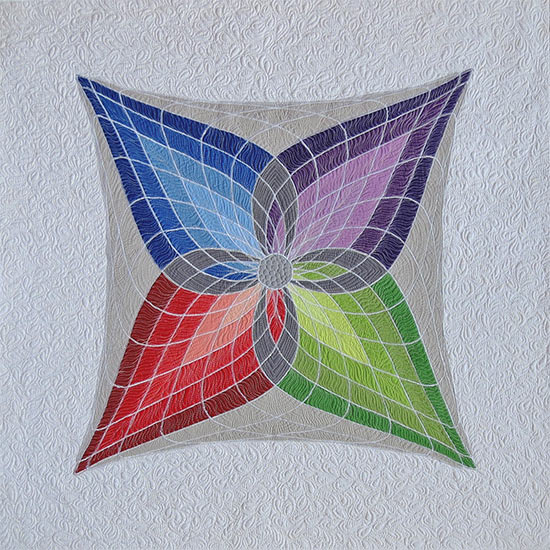
Geta! You are a winner at Blogger's Quilt Festival! I voted your quilt. 🙂
Congrats!
Great tips, thank you!
I must confess that I often sew over pins, when there are a lot of them! I will go slowly. Congratulations on the Bloggers Quilt Festival!!!! You deserve it!!
Susie
Hi Geta, the paper paper templates are a clever tip thank you, congratulations on your win!
That tip about paper templates is very helpfull! Thank you!
What a smart idea Geta – thanks.
Hi Geta! Thanks for all your tips! They are so helpful for me. I love your blog and your designs. I never put a comment before because my english is a bit poor, but always read you. Kisses!
Your work is extraordinary! Thank you for the tips!